How to calculate moment of intertia of a rectangle
Calculate the moment of inertia of a rectangle using the moment of inertia equations
 MJ Longinos
 Julianna Widlund, P.E
To calculate the moment of inertia of a rectangle, you need to know its dimensions and the axis of rotation. The moment of inertia measures an object's resistance to rotational motion about a specific axis. For a rectangle, there are two main axes of rotation: one passing through the center of mass (centroid) and parallel to its sides (I_x), and the other perpendicular to the sides and passing through the center of mass (I_y).
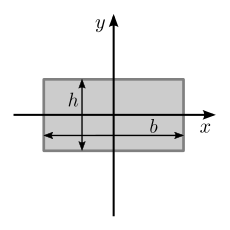
The formulas for calculating the moment of inertia of a rectangle about these two axes are as follows:
-
Moment of Inertia about the x-axis (I_x): I_x = (1/12) * m * (h^2 + b^2)
-
Moment of Inertia about the y-axis (I_y): I_y = (1/12) * m * (b^2 + h^2)
Where:
m = mass of the rectangle
h = height of the rectangle (distance between the parallel sides)
b = width of the rectangle (distance between the perpendicular sides)
You can also calculate the moment of inertia for a rectangle with our free moment of inertia calculator.
If you are dealing with a thin rectangular plate and want to calculate the moment of inertia per unit length, you can divide the above formulas by the length (L) of the rectangle:
-
Moment of Inertia per unit length about the x-axis (I_x): I_x = (1/12) * (h^2 + b^2) * (b/L)
-
Moment of Inertia per unit length about the y-axis (I_y): I_y = (1/12) * (b^2 + h^2) * (h/L)
Remember to use consistent units for the dimensions (e.g., meters) and ensure that the axis of rotation is perpendicular to the plane of the rectangle.
Put this into practice with our free Moment of Inertia Calculator.
Related articles

How to calculate overturning moment

How to calculate the moment of inertia of a circle

How to Calculate an Indeterminate Beam

Moment of inertia of a rectangle

Understanding Moment of Inertia: Formula and Equations

Moment of Inertia of a Circle and a triangle
Learn to build tools for yourself
Our Python for Civil Engineering certification walks you through publishing four tools like this one.
Enroll nowBeams are the most common structural element you’ll analyse, and the most common place a sign convention or support condition goes quietly wrong. These guides work through bending moment and …
Browse Beams & Structural Analysis hubInterested in learning more about automation?
Enroll on our training certifications and learn how to code, build AI applications with no-code tools and automate tasks.
Learn more